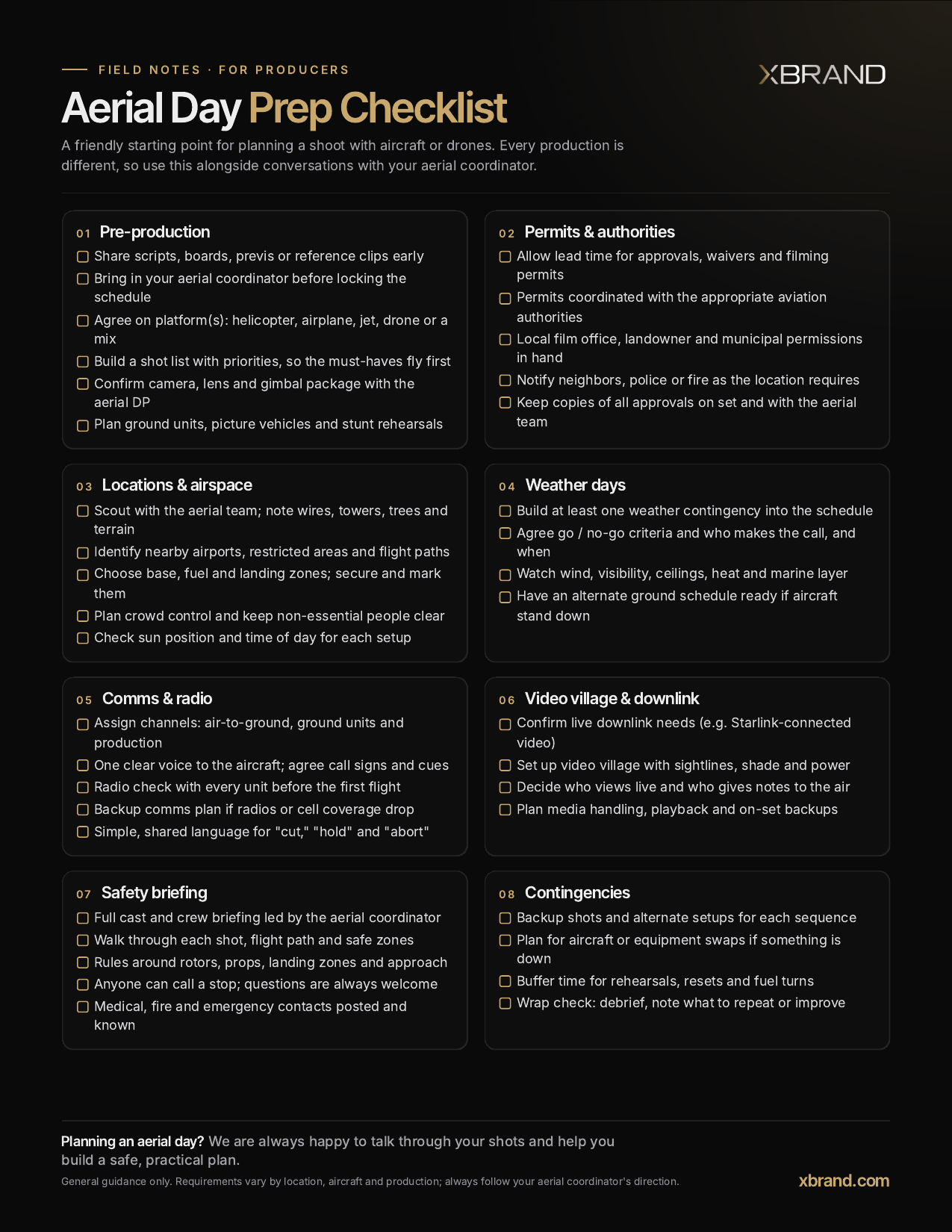
One of the first questions we hear from a production is some version of "What should we fly?" It is a great question, and the honest answer is almost always: it depends on the shot. There is no single best aircraft, only the one that fits what the camera needs to see, how it needs to move, and what the day can safely support.
These notes walk through the factors we weigh before anything leaves the ground. They are general by design; the best plan always comes from a conversation with your aerial coordinator.
Start with the shot, not the aircraft
Describe the moment in plain terms first. What is the subject, how fast is it moving, and how close should the lens feel? Is it a single reveal or a sequence that must repeat cleanly for coverage? Storyboards, previs or even a rough phone video help enormously. Once the shot is clear, the platform usually suggests itself.
Speed: match the subject
Speed is often the deciding factor.
- Drones shine at walking, running and driving speeds, and in tight spaces. They are nimble, quick to reposition, and can go where a full-size aircraft never should.
- Helicopters cover an enormous range, from a near-hover to fast car and boat work, and can change direction and height with real finesse. That versatility is why a camera helicopter such as our Astar H125 is so often the workhorse of an aerial unit.
- Camera airplanes like the Aerostar and the Phenom 300 come into their own when the subject is another aircraft, or when you need to cover long distances smoothly at higher speeds.
- The Cinejet, our L-39 camera jet, is built for the fastest subjects: jets and high-energy air-to-air work where a helicopter or propeller aircraft simply cannot keep pace.
A good rule of thumb: the camera platform should be comfortably capable of the subject's speed, with margin to spare, so the pilot can fly the shot rather than fight the aircraft.
Altitude and environment
Low, intimate work near the ground favors drones and helicopters. Big establishing shots, coastlines and cloud work may suit an airplane holding a steady line at altitude. Mountains, heat and elevation affect aircraft performance, weather affects everything, and your coordinator will factor in the airspace too.
Proximity and the feel of the lens
How close the camera gets changes the emotional temperature of a shot. Stabilized gimbal systems such as Shotover and IMMORTAL let a long lens hold a tight frame from a safe distance, so "close" on screen does not always mean close in the air. Two IMMORTAL gimbals can run at once on our camera airplanes, which means motion and stills, or two lens choices, can be captured in the same pass. When true physical proximity is needed, that is a conversation about pilot experience, rehearsal and safety margins, and it should happen early.
The subject (and the unusual requests)
Some shots call for something beyond a camera ship. A C-130 picture ship opens the door to large drops, skydiving, action sequences and heavy lift. The Moviehawk, a Black Hawk owned by Kenny Brown of Brown Helicopter, brings an unmistakable on-screen presence. An MD 500 or a Bell Huey can be the right picture aircraft, a camera platform, or both, depending on the story. Our drone division covers interiors, close work and scenes where a larger aircraft is not practical. Often the best plan combines platforms, each doing what it does best.
Safety is the frame around everything
Every aerial plan begins and ends with safety. That includes pilot and crew experience, rehearsals, clear communication with the ground, and coordination with the appropriate aviation authorities for permits and airspace. If a shot cannot be done safely, a good aerial team will say so, and will usually help find another way to tell the same story. At XBRAND, aerial coordination is led by Kevin LaRosa II, Managing Partner, Aerial Coordinator and Stunt Pilot, alongside Michael FitzMaurice, Managing Partner and Aerial DP, so the flying and the frame are planned together from the start.
Lead time
Aircraft, crews, gimbals and approvals all take time to line up. Simple drone or helicopter work can sometimes come together quickly; air-to-air, specialty aircraft, populated areas or stunts generally need more runway for planning, permits and rehearsal. Bringing your aerial team in early often saves a day.
Budget tradeoffs
Every production balances ambition against resources. A few honest tradeoffs to think about:
- One versatile platform flown well may serve a sequence better than several specialized ones.
- Dual-gimbal setups and well-planned shot lists can capture more in fewer passes.
- Weather days and backup plans cost less when they are planned than when they are improvised.
- Live downlink, including Starlink-connected video to video village, lets directors and clients approve shots in real time, which can reduce reshoots.
The goal is not the most aircraft or the most expensive one. It is the right tool for the story.
Let's talk through your shot
If you are weighing options for an upcoming project, we are always happy to talk it through, no commitment needed. Share what you are imagining and we will help you find a safe, practical way to get it on screen. You can reach the team at xbrand.com.